Showing posts with label PittsburghMarketingCompanies. Show all posts

Saturday, March 15, 2014

An Iliad: A Journey to the Past, Present and Future

A Journey to the Past, Present and Future

An Iliad, a modern adaptation of Homer’s Iliad by Lisa Peterson and Denis O’Hare, is the time-honored story of the Greek-Trojan war updated with modern language, contemporary references and future implications of the continued horror that is war.

Teague F. Bougere provides an enthralling performance is this one person show.  Alternately actor and narrator, Bougere as “The Poet” weaves the story of mortals and the gods of Greek mythology interspersed with references to conflicts throughout history up to 2014.  The epic story of Achilles and Agamemnon, Athena and Apollo, Helen of Troy and Hector, Hecuba and Hermes, Paris and Priam, and last, but not least, Zeus is told with an understandable pace, bringing this story with a historic sensibility to a current audience.


Bougere appears dusty and road-weary, then energized by the audience while engaging in easy banter, then repulsed by the dialogue of the classic tale.

The stage of Pittsburgh Public Theater’s O’Reilly Theater has been transformed to a quasi-construction site cum battlefield.   The rough-hewn table becomes Paris’ bed, then a platform for the recitation of conflicts and wars of far-reaching implications.  The scaffolding/ramparts provide a vantage for the observation of the historic battles from afar, as the majority of the audience experience war.

The Pittsburgh Public Theater’s production of An Iliad, a 90 minute show without intermission, plays at the O’Reilly through April 6, 2014.

Reviewed  by Joyce Kane on behalf of Positively Pittsburgh Live Magazine.  Joyce is the owner of Cybertary Pittsburgh, a Virtual Business Support business that helps solopreneurs, business owners and individuals work 'on' their business rather than 'in' the business.

Saturday, October 19, 2013

What a Show...What a Showman!

What a Show…What a Showman!

What can I say?  Brian Stokes Mitchell epitomizes all that is wonderful about Broadway music.  The ultimate showman, Mitchell electrified the stage at Heinz Hall, charmingly engaging with the audience in a round robin competition in the second act.


The Pittsburgh Symphony Orchestra, under the direction of guest conductor Ted Sperling, warmed up the audience with music from Carousel and Sweeney Todd.  An added treat, students from area colleges and universities, participants in the All-Star College Chorus, gave us two selections with the promise of more to come. The All-Star College Chorus is led by Robert Page and Christine Hestwood and includes students from California University of Pennsylvania, Community College of Allegheny County, Chatham University, Point Park University, Slippery Rock University, University of Pittsburgh, Washington & Jefferson College and Waynesburg University.

With music from Camelot, Porgy and Bess, Les Miserables, Ragtime among others, we were transported to the Great White Way, with familiar classics and a few new ones.  Mitchell and Sperling weaved in stories of their extensive relationship creating beautiful music together.  Add in pianist and friend Tedd Firth, and you get the benefit of three professionals who are so in tuned with each other that it almost felt like a performance around a living room piano rather than a concert hall.

I walked away from the performance with 3 favorites, 2 new ones and an old standard.  The “Waters in March” was a nice treat and made me smile with its uplifting message and Brazilian beat.  “New Word” is a touching and loving tribute to discovery of language between parent and child.  The glorious rendition of my personal anthem, the affirming “Impossible Dream”, thematic of continuing to strive no matter the obstacle, brought tears to my eyes.  The splendor of Heinz Hall, the soaring voices, and beautiful music of the orchestra all blended into a sumptuous experience.

The PNC Pops series with Brian Stokes Mitchell is at Heinz Hall through October 20, 2013.

Reviewed on behalf of Roving Pittsburgher by Joyce Kane.  Joyce Kane is the owner of Cybertary Pittsburgh, a Virtual Administrative support company, providing virtual office support, personal and executive assistance, creative design services and light bookkeeping.  Cybertary works with businesses and busy individuals to help them work 'on' their business rather than 'in' their business.  www.Cybertary.com/Pittsburgh

Sunday, October 6, 2013

Our Town: Comfort Food for the Soul

Our Town:  Comfort Food for the Soul


The 2013 Pittsburgh Public Theater’s production of Our Town (September 26 through October 27, 2013) is a transport back to simpler times when homemade cookies and milk freshly delivered by the dairy farmer characterized daily life.

PPT’s production of this venerable play penned by Thornton Wilder opens with “Stage Manager”, ably played by veteran Pittsburgher Tom Atkins (“The Chief") verbally  painting the picture of 1901 Grover’s Corners, NH.   The physical attributes of the small town, with its layout, descriptions of the movers and shakers, and the various homey details that characterized early 20th Century life in New England come to life for the audience despite the minimal set.  Grover’s Corners is portrayed as a quaint and charming mix of rural and city.   The town doctor is off delivering twins in “Polish Town”.  His wife, Mrs. Gibbs, and the neighbor’s wife, Mrs. Webb, have mirror gardens, with Mrs. Webb adding a soupcon of individuality with towering sunflowers to the mix of beans and heliotrope.  The daily chores of early morning breakfast preparation and getting the children off to school, not too dissimilar to modern families, lend familiarity that transcends time.

As the play progresses, we see other hints of the familiar…the classroom crush, the adulation of a sports figure, respect and concern for the hardworking neighbors.  These all serve as an escape, a salve for the over-stressed and over-connected audience who is seeking a respite from their everyday lives with the continuous avalanche of bad news.  Yes, there is bad news in Grover’s Corners, but perhaps the pace is more acceptable, the volume of negativity more absorbable.

The rhythms of life – birth, marriage, death – are set with minimal distractions.  The costuming is bland so as not to stand out.  The few chairs, tables, ladders that represent the staging are effective if nonintrusive.  Even the pantomime of meal preparation, carrying books and leading the horse delivering the milk wagon through the town are evocative without being overly trite.  Preparation of the strawberry sodas at the drug store/apothecary produced a chuckle of memory from many in the audience – helped along by Atkins’ mobile expressions.


Our Town’s ensemble cast, liberally full of Gibbs’, Webb’s, other small town characters and ‘citizens’, weave Wilder’s words to create the meatloaf and mashed potatoes of small town country living that gives comfort without being sappy  . . . comfort food for the soul.  

Reviewed by Joyce Kane on behalf of Positively Pittsburgh Live! Magazine.

Joyce Kane is the owner of Cybertary Pittsburgh, a Virtual Administrative support company, providing virtual office support, personal and executive assistance, creative design services and light bookkeeping.  Cybertary works with businesses and busy individuals to help them work 'on' their business rather than 'in' their business.  www.Cybertary.com/Pittsburgh

Monday, September 30, 2013

I Have Seen The Enemy and It is Us


Review by Joyce Kane


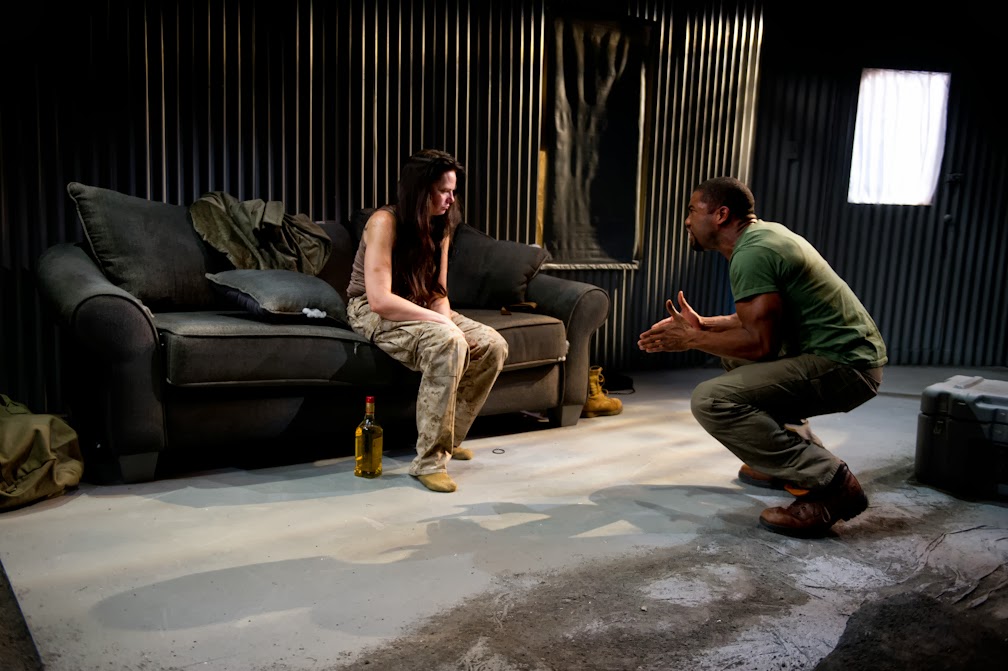
The REP’s current offering, Soldier’s Heart, is a gritty and intense view into the gender differences in the military.  The play opens with a seemingly realistic, well-adjusted single mother preparing for her first deployment to Iraq.  Casey Johnson, a sergeant in the Marine Corps, has her son Sean’s athletic and academic schedule for the ensuing 9 months calendared and cross referenced by month, along with medical records and pre-recorded stories and letters.  In the interchange with her mother, we become aware that perhaps Casey has something to prove.  Her father, an embittered veteran who spent time in Vietnam, came home a changed man.  Both of Casey’s parents used alcohol to assuage the pain of the downward spiral of their relationship.  Her father left Casey his house upon his death 6 months earlier, to her mother’s apparent resentment.  Casey is estranged from Sean’s father, but he shares custody and childcare with Casey and now with her mother.
Marie Elena O'Brien, Jenna Cole

In a rapidly unfolding barrage of videos, we get a glimpse into the horrors of war in Iraq.  There are two women in the company; rather than bonding with each other, Casey and Lance Corporal Hernandez appear to spar, verbally and culturally.  The plight of a female deployed in a foreign country is presented with a raw, matter of fact style.  Personal hygiene and the status of women in Iraq reveal underlying tensions that belie the status of woman in the US.

Michael Fuller, Marie Elena O'Brien

Casey’s return stateside reveals a shattered woman.  She refuses to see her son; she refuses to engage in life.  Her heart has turned from open and accepting to hard and unyielding.  She finds her father’s stash of tequila and liberally partakes to numb her memories of the horrors that she experienced.  She contemplates suicide and disengages from any interpersonal contact.  She can no longer bear to be touched, preferring the isolation of video games and television in which to immerse herself.

Marie Elena O'Brien, Joshua Elijah Reese

Humor relieves some of the dark content.  Kevin, Casey’s ex and "Mr. Analogy", is a spark of reason, appealing to the Casey of old to try to bridge the actions of the mother of his child with this stranger. The secrets of what transpired over the nine months continue to be unraveled and erode our sense of respect and honor for our perceived heroes.

Tammy Ryan

The Studio Theatre of the Pittsburgh Playhouse is the venue for the world premiere of the play, written by Pittsburgher Tammy Ryan and directed by John Amplas.  The staging and lighting are stark and gray, befitting the mood of the work itself and the audience’s reaction.  The use of the same set for both stateside and Iraq was enhanced by the videos projected on the back wall; the videos also served as a flashback mechanism, a graphic demonstration of what Casey encountered in Iraq.


Justin Lonesome, Marie Elena O'Brien

Marie Elena O’Brien is remarkable as Casey Johnson.  The range of emotions that she displays throughout the performance is heart-wrenching.  Joshua Elijah Reese as Kevin is likable; you root for him to be successful in breaking through the shell, helping and supporting Casey in her return to life.  Margie, Casey’s mother, ably portrayed by Jenna Cole, is everywoman, while not perfect, loves her daughter and grandson and tries her best.  Michael Fuller (Captain Baines, Casey’s Commanding Officer), Justin Lonesome (Staff Sergeant Williams), Jaime Slavinsky (Lance Corporal Hernandez), and Sundiata Rice (Sean) round out the small but emotionally powerful cast.  Kudo’s to Rice in his debut as Sean, Casey’s son, who idolizes her and cannot understand their estrangement.  When Casey does not respond to his heartfelt, innocent appeals, we are left to imagine that no one will be able to break through to her.

Casey has seen the enemy…and it is us.

Soldier’s Heart runs through October 13th at the Pittsburgh Playhouse.

Photo Credit for Cast of Soldier's Heart:  Jeff Swensen

Reviewed  on behalf of PositivelyPittsburghLive! Magazine.  Joyce Kane is the owner of Cybertary Pittsburgh, a Virtual Administrative support company, providing virtual office support, personal and executive assistance, creative design services and light bookkeeping.  Cybertary works with businesses and busy individuals to help them work 'on' their business rather than 'in' their business.  www.Cybertary.com/Pittsburgh

Sunday, June 23, 2013

CLO's The Phantom Entertains

The Phantom
The Pittsburgh CLO’s production of Kopit & Yeston’s Phantom combines enough of the drama of the more well-known Andrew Lloyd Webber version of the love story to be reminiscent yet is unique enough in its handling of the story to stand apart.

Based on the Gaston Leroux novel “Le Fantome de L’Opera”, Arthur Kopit’s book and the theater version provides more of a character study into the back story of the why of The Phantom.  In the K&Y version, The Phantom is more humanized and has a name, Erik.  While he skulks backstage, on the catwalk and in the underbelly of the famed Paris Opera House, his character is portrayed with more sensitivity, evoking empathy rather than horror.  His story, revealed in the second act, provides insight into a much more likeable, even playful character.  The K & Y version is essentially more accessible to the audience.

I did take issue with one aspect of the second act revelation of Erik’s story – not the story itself, but on relying on the ballet convention a la “An American in Paris” or “Oklahoma”; it felt a tad trite for my taste, a less than novel treatment to expose how the legend of The Phantom came to be.

Carlotta

Another departure from the more popular ALW version is a broader cast, with effective use of the ensemble, and without the need for the more dramatic special effects that characterize the better known variation.  I found that I preferred it.  The music and lyrics by Maury Yeston, while less recognizable, were still effective to weave the story of the young ingénue, Christine Daee.  Initially relegated to the wardrobe department, she rises to the position of lead under the tutelage of Erik, unbeknownst to the conniving and controlling La Carlotta, the quintessential diva.  Despite her lack of talent, Carlotta (Donna Lynne Champlin) is the feted queen of the Opera House, due solely to her husband’s wealth and the currying of well chosen benefactors who continue to support the opera despite repeated failures of the productions.  This production has a fair bit of humor mixed in the dialogue, giving the audience even more entertainment and causing me to comment at intermission that I preferred it over the noir version that I had seen numerous times.

Christine and The Phantom


The lovely soprano of Erin Mackey as Christina melodiously blends with Ron Bohmer’s (The Phantom) tenor.  Veteran Jaime Ross as Gerard Carriere, the former Opera House manager, is credible as Erik’s mother’s married lover and subsequent protector of Erik.  You feel his emotional tug of war as he at last reveals his parentage and performs the ultimate paternal act in the final scene.
Christine and Philippe
The character of Philippe de Chandon (Bryant Martin) first discovers the talents of Christine and urges her to develop her voice with vocal training.  He becomes smitten with his discovery, leading to a jealous reaction on Erik’s part.  Thus spins the love story between two unlikely characters, the beautiful Christine and the disfigured Erik.

On opening night, the audience responded well to the production, delivering a standing ovation to the cast.  If you get the chance to see this alternate production of the Phantom, do take advantage of the opportunity while it is in town.  The show runs through June 30, 2013 at the Benedum.

Photo Credit:  Matt Polk

Reviewed on behalf of Positively Pittsburgh Live! Magazine by Joyce Kane.  Joyce  is the owner of Cybertary Pittsburgh, a Virtual Administrative support company, providing virtual office support, personal and executive assistance, creative design services and light bookkeeping.  Cybertary works with businesses and busy individuals to help them work 'on' their business rather than 'in' their business.  www.Cybertary.com/Pittsburgh

Sunday, June 9, 2013

Other Desert Cities Explores the Extremes in Family Dynamics


Other Desert Cities


Pittsburgh Public Theater’s production of “Other Desert Cities” is a study in family dynamics of polar extremes.  The first act unfolds on the morning of Christmas Eve following a family tennis match. The patriarch, Lyman Wyeth and his wife, Polly, are presented as old guard Republicans, conservatives of the far right; their children, Brooke and Trip, are clearly political adversaries, young liberals of the self-righteous left.

John Patrick Hayden (l) with James DeMarse
Shortly into the first act, we get an inkling of a tragedy that helped to define the tensions in the family that go beyond politics.  As the story unfolds, we hear of an older brother, hero to Brooke, embarrassment to Lyman and Polly, whose anti-war, drug abusing, cult leanings drive a wedge into family loyalties.  Brooke, an author, reluctantly admits that her latest oeuvre is a memoir that presents her version of her brother’s disappearance and probable suicide after a bombing at a military recruiting center leaves one dead.  Is it accurate?  Maybe.  Is it romanticized? Probably.  Is it the last ingredient in the estrangement stew with her family?  Most definitely.

Extremes in politics, mental stability, familial loyalties, emotional swings, economic status and value-systems mark the dialogue, which is often adversarial yet laced with humor.

Pilar Witherspoon (l) and Helena Ruoti
The acting is dynamic; the characters larger than life.  There is familiarity with them, yet strangeness.  The shifting alliances allude to the dynamics that face all families.  Lyman, a former actor turned politician turned ambassador turned man of leisure (or is that man of torment?), is brilliantly portrayed by James DeMarse.  His loyal wife, suggestive of Nancy Reagan, is a bit more strident in her opinions and pronouncements.  Polly (Helena Ruoti) and her former screenwriting partner, her sister Silda (Susan Cella), were successful with a series of movies, the Hillary chronicles.  Silda and Polly, originally from Texas, may bear a family resemblance and similar upbringing but they are polar opposites on other characteristics.  Silda is recuperating from a recent stint in rehab at her sister’s home.  She reluctantly and sarcastically accepts the situation that her life has become, intermixing wisecracks with self-deprecation.  The comic relief is tinged with sorrow – or perhaps guilt - with her role in her nephew’s downslide from upper middle class trust fund baby to societal pariah.

l to r Helena Ruoti, Susan Cella, John Patrick Hayden, Pilar Witherspoon
Brooke (Pilar Witherspoon) is a distraught, freelance author who lives on Long Island, as far away geographically and emotionally as she can be .  She eschews financial help from her parents, preferring to go it alone on a more modest scale that her parents struggle to understand.  Her emotional history is unveiled.  The audience hears of her being institutionalized with hints of the instability rooted in her childhood.  Her brother, Trip (John Patrick Hayden), a reality TV producer, provides some evenness in contrast to Brooke’s uber emotionality.  He, of all of the characters, seems to be the one with the least baggage.

The setting of the living room with its stacked stone fireplace reflective of the colors of the desert as a backdrop to the open fire pit is reminiscent of old Hollywood, Rat Pack era.  You expect to see Frank and Dean stroll in the sliding glass doors.  The name dropping of the California elite who are the quintessential representatives of the sixties and seventies, bridge the fantasy with reality.  The elegance of the crystal decanters and tumblers are in sharp contrast to the ruggedness of the walls, the silk and Pucci of the older generation to the jeans, shorts and T shirt of the younger.

PPT’s playbills, in addition to listing the cast and creative staff bios, season sponsors and advertisements, provide some context for the work that is presented.  For “Other Desert Cities”, the audience is treated to a match game of political contrasts (Al Franken in the same quiz as Shirley Temple Black) as well as descriptions of the individuals and venues that are the name dropped references, the likes of Totie Fields, Dinah Shore, the Brown Derby and Mrs. Annenberg.

 “Other Desert Cities”, where families put the ‘fun’ in dysfunctional.  See if you recognize traits of your own.

“Other Desert Cities” is the final production in the 2012-2013 season for PPT.  It runs through June 30 at the O’Reilly Theater.

Photo credit: Pittsburgh Public Theater
Reviewed on behalf of Positively Pittsburgh Live Magazine by Joyce Kane.  Joyce  is the owner of Cybertary Pittsburgh, a Virtual Administrative support company, providing virtual office support, personal and executive assistance, creative design services and light bookkeeping.  Cybertary works with businesses and busy individuals to help them work 'on' their business rather than 'in' their business.  www.Cybertary.com/Pittsburgh

Monday, May 20, 2013

Aloha Meenakshi


Aloha Meenakshi

NAWBO Greater Pittsburgh Chapter honored their President, Meenakshi Kapoor, at an “Aloha Meenakshi” luncheon at the Grand Concourse, Station Square.  In Barbara Walters’ style, Joanne Quinn Smith interviewed Meenakshi on her fascinating story of her journey from a casual visitor stateside to a multi-million dollar entrepreneur.  Meenakshi first visited the states for a 6 month vacation, time that had been earned from a position in New Delhi where she had not taken a vacation in six years.  This was our initial glimpse into the dedication, selflessness and focus that would awe and inspire the attendees.

Meenakshi decided to stay after she was hired for a position in New Jersey, pursuing a career in HR.  Fast forward to several relocations and disappointments, and Meenakshi landed in Pittsburgh where she knew no one.  When she faced yet another relocation request to Charlotte, she decided that she had enough of the nomadic life.  With a $250 investment, Meenakshi and a partner decided to launch Symphony Enterprises, LLC.

Symphony Enterprises, LLC is an IT staffing firm, leveraging Meenakshi’s background in HR to source, recruit and place outsourced technical talent for firms.  From its humble beginnings, Symphony has exceeded $2 Million in topline revenue and is on track to continue the upward trajectory.  Meenakshi shared how she used cold calling and other low costs marketing practices to grow her business.

Meenakshi credits the members of NAWBO Greater Pittsburgh for offering friendship, support and important resources to buoy her forward.  In 2010, she earned her citizenship; as a result, she sought and received several key certifications, including WBENC and 8 (a).

Aloha is Hawaiian meaning both ‘hello’ and ‘goodbye’.  Meenakshi married in November of 2012 and the reason for the Aloha luncheon is she is returning to Mumbai for the next chapter of her life.  We know she will continue to succeed and look forward to her return visits to keep her NAWBO sisters in the loop.
Aloha Meenakshi – we will all miss you.

The interview can be seen on the NAWBO Channel of Positively Pittsburgh Live! Magazine.  Each attendee had the opportunity for a videotaped 30-second commercial which will also be posted to the NAWBO channel.  Tune in for the entire interview as well as the commercials.

Written and posted on behalf of RovingPittsburgher and Dreamweaver Marketing Associates.  Joyce Kane is the owner of Cybertary Pittsburgh, a Virtual Administrative support company, providing virtual office support, personal and executive assistance, creative design services and light bookkeeping.  Cybertary works with businesses and busy individuals to help them work 'on' their business rather than 'in' their business.  www.Cybertary.com/Pittsburgh

Saturday, April 27, 2013

It Isn’t a Matter of Race; it’s a Matter of Taste


It Isn’t a Matter of Race; it’s a Matter of Taste

Playwright Bruce Norris
Clybourne Park, the Pulitzer Prize (2011) and Tony Award winning play by Bruce Norris, is a tale of contrasts; contrasts in race, beliefs, social circumstances, fashion and style and, most importantly, time.

Act One is set in the late 50’s at the home of Russ and Bev (Brad Bellamy and Lynne Wintersteller).  They are clearly middle class.  Silver candlesticks and a chafing dish grace the dining room built-in server, ready to be packed for their imminent move to suburbia and the nirvana of a 6.5 minute commute to Russ’s new corner office.  Bev, a cross between Laura Petri and Lucille Ball, chastens – no nags – Russ out of his apparent funk.  It is early afternoon and Russ remains in his pajamas, eating ice cream from the carton, a tad Archie Bunker-esque ensconced on his throne.  Their retainer, Francine (Chandra Thomas), is anxious to leave.  She has come to assist them with their move on a Saturday and would prefer to be unseen and unnoticed, not dragged into the dark issues swirling in the home.  Through the seemingly well-intentioned visits of the simpering Pastor Jim (Jared McGuire), pretentious Karl (Tim McGeever), and deaf and clueless Betsy (Megan Hill), the story unfolds to reveal the parents’ guilt and self-loathing over their son’s suicide after his return from the Korean War.  Karl and Jim are appalled to learn that Russ and Bev’s home has been sold to a family of color, the first in the neighborhood.  They are even more appalled that he doesn't care.

Megan Hill and Tim McGeever as Lindsey and Steve, Photo Credit : Pittsburgh  Public Theater

Fast forward 50 years later and the same home is the heart’s desire of a young couple who are anxious to move back to the city, welcome their child and herald the gentrification of Clybourne Park.  However, their version of gentrification is a forklift upgrade of the property, losing the historical integrity of the neighborhood in favor of a spacious open concept, multi-story edifice, just as their version of race relations doesn't quite match how others may feel.  Political correctness replaces the veiled messages of fifty years earlier, the styles of the 50’s are transformed to the more casual shorts, tees and leggings, and the ever-present mobile devices are more important than human interaction.  The change in social standards is mirrored in the transition from the crystal glass of iced tea to the pop-top beer can and Starbucks vente.

Chandra Thomas (Lena) and Lynne Wintersteller (Kathy) Photo Credit:  Pittsburgh Public Theater

While everyone circles around the issues, particularly of class and race, and Lindsey tries to prove her liberal views of race relations, Lena delivers the ultimate put down:  It isn’t a matter of race; it’s a matter of taste

The second act has a surprising ending and brings the story full circle to the causal impact of Kenneth’s suicide, a microcosm of chaos theory that starts a chain of events that could not be predicted.

The cast is to be commended for playing multiple characters between the two acts, all tied together by the house that is the stage and the set.  Bjorn DuPaty (Albert/Kevin) plays a small but pivotal role in bringing clarity to language rendered muddy by obfuscation and political correctness.  He focuses a laser on the hypocrisy of Ken and Jim, Lindsey and Steve.

Throughout the play, the dialogue engages the audience, evoking humor and embarrassment, recognition and discomfort.  The mood of the play moves seamlessly from a bluesy ballad by Frank Sinatra to the stimulation of Hip-Hop of current times.

The Playbill offers several, upcoming local examples of ‘white flight’, ‘gentrification’, and ‘economic eviction’.  Though Clybourne Park is set in Chicago, we are left to wonder how often the pathos of Clybourne Park has been played out in the gentrification of the neighborhoods of the Mexican War Streets, Manchester, NorthSide, Lawrenceville and SouthSide.


Clybourne Park continues at the O’Reilly Theater through May 19th.

Posted on behalf of Positively Pittsburgh Live Magazine.  Joyce Kane is the owner of Cybertary Pittsburgh, a Virtual Administrative support company, providing virtual office support, personal and executive assistance, creative design services and light bookkeeping.  Cybertary works with businesses and busy individuals to help them work 'on' their business rather than 'in' their business.  www.Cybertary.com/Pittsburgh

Monday, April 15, 2013

Riveting "Our Class" Opens PICT Season


But What Could I Do?

The Pittsburgh Irish & Classical Theatre’s (PICT) production of “Our Class” is a riveting and relentless story that has at its fundamental core the theme of man’s inhumanity to man.  As emotionally draining as the play is for the audience, one cannot imagine how the small but dedicated troupe can continue the pace of an almost three hour production spanning seven decades.

From early childhood through the beginning of the 21st century, Tadeusz Slobodsianek’s work follows ten classmates from the small, rural village of Jebwabne in Poland.  The ten, evenly divided between Jews and Catholics, start out as eager, playful eight year olds.  The German invasion with subsequent Russian support, followed by German re-occupation ignites the socio-political environment of anti-semitism, enemy collaboration, torture, revenge killings and the extermination of 1,600 Jews by fellow villagers.  The latter was initially attributed to the occupying Germans, but the playwright adopts the position of Jan Gross’ book Neighbors to reveal that the same classmates who played together guilelessly were the perpetrators of the herding into the barn and burning of their Jewish neighbors.   And while others continue to dispute that work and offer counter theories to what transpired on that fateful July day in 1941, history shows that it is possible, even conceivable, even though we would rather not admit it.

What is fascinating is the human study in group think and the continued self-justification for turning a blind eye to atrocities too enormous for most of us to fathom – ‘What Could I Do?’  The horrors of genocide perpetrated on neighbors and former classmates, combined with murder, torture, interrogation, rape, theft, infidelity – a continuous verbal assault on the moral conscience.

Clarinetist Susanne Ortner-Roberts
The staging is bare and stark, reflective of the bare and stark nature of the subject and the times.  Ten wooden chairs, a chain link fence and a chalk board that acts as the scene changer (annotated Lessons) are complimented by the concrete floor, piles of cinderblock, metal runged ladders and focused lighting.  As each cast member passes, whether by violence, illness or time, they exit the main performance area in a slow-motion, studied manner to observe from their afterlife behind the barrier of the fence.  Their haunting of the remaining characters, whether in reality or through a guilty conscience, is accompanied by the evocative clarinet of Susanne Ortner-Roberts.

Director Aoife Spillane-Hinks makes her U.S. directing debut with “Our Class”, perhaps drawing in part from the civil unrest in her native Ireland to explore the age-old neighbor as neighbor, neighbor as villain and neighbor as victim dynamics.

Director Aoife Spillane-Hinks
The cast is to be commended for playing the characters through all stages of life, spanning from two to seven decades, depending on their fate.  With a tip of the hat to irony, Abram, who was fortunate to emigrate from Poland to New York and thus escaped the extermination, furthers the story through letters and an ultimate return to the village of his birth.  His recitation of all of his ancestors and his own issue represented my one negative with the play…okay, we get it already – you came from a big family and you fathered a big family.

The cast featured several familiar faces to the PICT stage, including Bernard Balbot (Jakub), Katya Stepanova (Dora), Vera Varlamov (Rachelka/Marianna), Jonathan Visser (Zygmunt), and Aaron White (Menachem).  Those making their PICT debut were Justin Fortunato (Henick), Rafael Goldstein (Abram), Jimmy Mason (Rysiek), Caroline Shannon (Zocha) and Quinn Patrick Shannon (Wladek).

Rather than the refrain of ‘What could I do?’, perhaps they should have asked ‘What can I do?’  The audience is led to counter with ‘What should I do’ to their own introspective ‘What would I do?’.

“Our Class” runs from April 10th through May 4th at the Henry Heymann Theatre at the Stephen Foster Memorial, University of Pittsburgh’s Oakland campus.

Our Class was reviewed by RovingPittsburgher Reporter Joyce Kane, Owner of Cybertary, a Virtual Administrative support company providing business support services on and On-Demand basis for our clients.  We help you work 'On' your business instead of 'In' your business.

Saturday, December 8, 2012

Shakespeare Meets the Stooges in The School for Lies


Shakespeare Meets the Stooges in The School for Lies


The Pittsburgh and Irish Classical Theatre’s production of David Ives’ “School for Lies” melds the elegance of language with the comedic tour de force of slapstick.  Ives renders Molière’s original dialogue in over the top rhyme, blending contemporary themes with 17th Century cultural ennui.

PICT’s production, mixing the classy and the crass in somewhat balanced proportions, stars Leo Marks as Molière’s truth-telling society hater, Frank. An unlikely name for a Frenchman of 1666, true, but Ives takes lavish liberties with his model. He adds farcical fanfare to “The Misanthrope” plot and blends generous helpings of current vulgarity into verse that mimics the simpering style of the Paris salon aristocrats.

Leo Marks and Nike Doukas as Frank and Celimene
  
Satire and scatological humor pair seamlessly in the witty and sometimes barbed verse.  The audience was left with the challenge of keeping up with the fast-paced socio-economic commentary when it switches from the present-day to the French classic and then back again.  Among the horrors Frank cannot abide are the hordes of the overweight in flip-flops blocking sidewalks: “Each one upholding our most sacred law:/The people’s right to suck a soda straw.”


The salon of Celimene (Nike Doukas) is the setting, with all the sumptuousness and excess that marked that era of French history.  The glittering crystal, silks, satin and lace evoke a time of majesty rivaled only by the backstabbing duplicity of court-wannabees and where the word play presented “gossip” as “reporting”…perhaps a touch of “Entertainment Tonight” or “Access Hollywood”?

Celimine with her admirers

Celimine (Nike Doukas) and Arsinoe  (Helena Ruoti)
Celimene plays to the crowd of anxious suitors with stinging impersonations of a sleazy lawyer in rap and an acquaintance/rival who channels the best of valley girl affectations – please, no more use of the word ‘like’!

Frank, his name a play on a synonym for candor, cannot stand the hypocrisy that surrounds him.  He initially scorns Celimene but when she mistakenly believes he has influence at court to assist her with her impending suit, she elects to turn her feminine wiles on full blast to make him yet another convert.  He quickly becomes enraptured, joining the other sycophants scattered at her feet.  Eliante (Robin Abramson), Celimine’s ingénue cousin ignores Frank’s friend and apologist Philinte (Joel Ripka) and literally throws herself at Frank.  At the same time, the devious Arsinoe (Helena Ruoti), while scheming to destroy Celimine’s reputation, finds herself entranced with the aloof Frank.

Mr. Ives descends a few notches below the comic refinement that Molière achieved in “The Misanthrope,” which is considered the ‘pinnacle of his art for the nuance of its portraiture and the sharpness of its satire’. In its more base characters and emphasis on lewd sexual humor, “The School for Lies” often evokes the bawdy bent of British comic playwrights influenced by Molière rather than the French master himself.

With a nod to Shakespeare’s comedies as inspiration, Ives employs the running joke regarding a man in drag as a focus on the bard’s tried and true disguise and revelation technique to bring the play to culmination.  The slapstick element, with the plate of canapés being repeatedly tossed in the air and the long suffering Dubois setting about to clean up, did get to be a tad tedious, although one member of the audience continued to murmur “ahhhhh” in sympathy every time, while the rest of us seemed to feel enough was enough.

The PICT ensemble cast did a terrific job with the complicated dialogue, demonstrating even on opening night the consummate professionalism of the troupe. The School for Lies runs through December 15th at The Charity Randall Theatre, Stephen Foster Memorial, University of Pittsburgh.

THE SCHOOL FOR LIES
By David Ives, based on Molière’s “Misanthrope”
Directed by Andrew S. Paul
Leo Marks as Frank
Nike Doukas as Celimine
Joel Ripka as Philinte
Robin Abramson as Eliante
Helen Ruoti as Arsinoe
Martin Giles as Oronte
James FitzGerald as Acaste
Matt DeCaro as Dubois/Basque

Reviewed by Joyce Kane on behalf of Dreamweaver Marketing Associates.  Joyce Kane is the owner of Cybertary Pittsburgh, a Virtual Administrative support company, providing virtual office support, personal and executive assistance, creative design services and light bookkeeping.  Cybertary works with businesses and busy individuals to help them work 'on' their business rather than 'in' their business.  www.Cybertary.com/Pittsburgh

Sunday, August 12, 2012

Ivanov Amazes


The Pittsburgh Irish & Classical Theatre’s Chekhov Celebration continues with the classic Ivanov, Anton Chekhov’s play that explores the meaning of life and love in pre-Revolutionary Russia.  Not nearly as dark as other Russian works, Ivanov is billed as a comedy.  Comedy may be pushing it a little far. Although there were moments of laughter (and indeed, one member of the audience in Saturday evening’s performance erupted into laughter even when the rest of us didn’t find the humor); I would term it a tragi-comedy.

Nike Doukas as Anna seeks solace from David Whalen's Nikolay
Pulling on real life experiences as a doctor and tuberculosis sufferer, Chekhov weaves the story of Nikolay Ivanov, a self-loathing, deeply in debt gentleman farmer whose once-loved yet now disdained wife is suffering from the disease.  He wants to be alone, to read and intellectualize his existence, but his neighbors simply won’t allow it.  While the characters whine about boredom and spend their hours pursuing gluttony, liquor, gossip and card playing as further evidence of their dissipated lives, the audience is reluctantly drawn in to observe his suffering with an interesting mix of tears and laughter.

David Whalen portrays the title character replete with Hamlet-like angst exuding an unexplained grief coupled with frustration and self-hatred.    Selfish to the end, Nikolay finally ends his suffering instead of finding happiness with the young and impressionable Sasha (ingénue Katya Stepanova) on their wedding day.
Martin Giles and Katya Stepanova

Well-staged in The Charity Randall Theatre in the Stephen Foster Memorial on Pitt’s campus in Oakland, the small platform is transformed  alternatively as an estate garden, an elaborate reception area replete with crystal chandeliers and a well-appointed study.

Tom Stoppard offers this adaptation to modern audiences by brilliantly bringing the dialogue up to current, understandable prose.  The costumes by PICT veteran designer, Pei-Chi Su, evoke the glamour and excess of the Russian elitist society.

l to r:  Alan Stanford, Matt DeCaro, Jonathan Visser, Martin Giles
The supporting cast is strong, with Alan Stanford as the indomitable Count, Megan McDermott as the title seeking, moneyed young widow Marfa, Matt DeCaro as the scheming estate manager Borkin, and Leo Marks as the idealistic (and honest, as he continuously reminded us) doctor who attends the ill-fated Anna Ivanov (Nike Doukas).  Martin Giles, the emasculated chum from University days Pavel Lebedev, offers Nikolay refuge from the stresses of his depressing home life despite his wife Zinaida’s incessant harping on collecting the money owed to them.  Zinaida’s (ably portrayed by veteran Helena Ruoti) acerbic disdain for Ivanov typifies the classes within classes of most elitist societies.

Having seen two of the four offerings in the series, I was entranced by the talent of the cast and their ability to portray lead and supporting roles seamlessly from play to play.  This is no mean feat, considering the length of the monologues and the interleaving timing of the performances.

Ivanov continues for 3 more performances, through August 25th.

Photo Credit:  Suellen Fitzsimmons

Posted on behalf of Dreamweaver Marketing Associates.  Joyce Kane is the owner of Cybertary Pittsburgh, a Virtual Administrative support company, providing virtual office support, personal and executive assistance, creative design services and light bookkeeping.  Cybertary works with businesses and busy individuals to help them work 'on' their business rather than 'in' their business.  www.Cybertary.com/Pittsburgh